


What the MZ Generation's Turn to Buddhism is Teaching Us
- Brian Lee

- 22 hours ago
- 12 min read
What the MZ Generation's Turn to Buddhism is Teaching Us
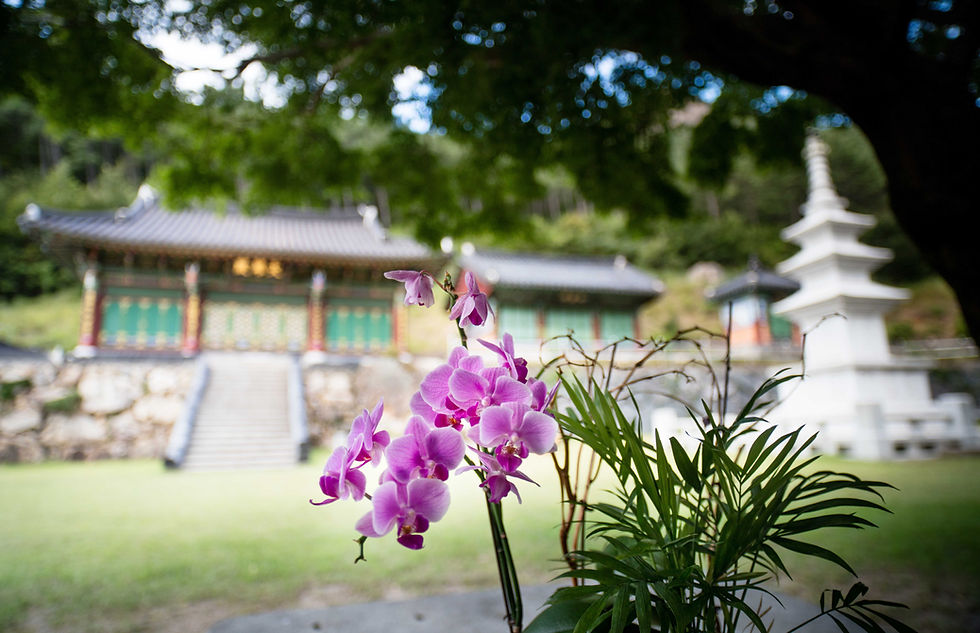
A recent KBS documentary stopped me in my tracks. The segment explored a quietly remarkable phenomenon sweeping South Korea: the MZ generation — Millennials and Gen Z — flooding into Buddhist temples, signing up for strict temple-stay programs, and filling massive Buddhist expos in Seoul. Monks performing EDM sets lyrically packed with core Buddhist doctrine. Viral chocolate Buddha statues sold at festivals specifically designed to melt in the hand — an edible, embodied lesson in impermanence and the letting go of ego. Trendy Buddhist cafes in Gangnam where young professionals sit in intentional silence, not to scroll, but to think (KBS, 2025).
At first glance, this might look like a cultural fad — Buddhism as aesthetic. But the data tells a more serious story. A 2024 survey found that 51 percent of South Koreans now claim no religious affiliation, while Buddhism's favorability rating among 18–29 year-olds rose to 56.2 out of 100 — up 5.3 points in a single year (Hankook Research, 2025). The Jogye Order, Korea's largest Buddhist body, drew a record 250,000 visitors — Gen Z predominating — to its 2026 Seoul International Buddhism Expo (Lewis, 2026).
Meanwhile, on the other side of the Pacific, a parallel phenomenon has been unfolding among American young adults. Disaffected evangelicals have been crossing into Anglican parishes, Eastern Orthodox churches, and Roman Catholic cathedrals in notable numbers. Catholic dioceses across the United States reported an average 38% increase in the number of adults entering the church through formal initiation programs this past Easter (Religion News Service, 2026). As writer Gracy Olmstead observed in The American Conservative, young people are searching for something with "sacramental" weight — a faith that feels ancient, embodied, and real (as cited in Anglican Province of America, 2022).
Two continents. Two very different religious expressions. One unmistakable signal.
I. Spiritual Hunger: The Ache That Won't Go Away
The Westminster Larger Catechism opens with a declaration that is easy to overlook in its simplicity: man's chief and highest end is "to glorify God, and fully to enjoy him forever" (Westminster Assembly, 1647). Augustine, standing in that same stream, wrote what every honest human heart eventually confirms: "Thou hast made us for thyself, and our heart is restless, until it repose in Thee" (Augustine, 397/1991, p. 3).
Scripture does not treat this restlessness as an accident. The Preacher of Ecclesiastes wrote that God "has put eternity into man's heart" (Eccl. 3:11). The word used — olam — carries the sense of a vast, indefinite duration, a longing that exceeds any earthly satisfaction. This is not a design flaw. It is the divine signature. We were made for worship, and when that worship is displaced, it does not disappear — it migrates.
What are Korean MZ's actually looking for in Buddhism? The KBS documentary is revealing. They are not, by and large, seeking doctrinal instruction. One young interviewee offered a simple but striking explanation: she loved Buddhism because "it understands my heart and doesn't force anything on me" (KBS, 2025). What she described was not apathy toward truth but exhaustion with pressure — a longing for a space where her soul could breathe. Hundreds of thousands of non-religious young people are now flocking to temple stays not for entertainment, but for the strict schedules, the prostrations, and the profound, uninterrupted silence (KBS, 2025). They are choosing discipline without coercion — and finding it restorative.
South Korea's MZ generation makes up 33% of the national population yet faces crushing housing costs in Seoul, record-breaking youth unemployment, and a loneliness epidemic so severe that the government established a formal Ministry of Loneliness and Population Crisis (Daxue Consulting, 2025). These are a burnt-out, highly anxious generation living under intense social pressure. They are not looking for easy answers. They are looking for a faith that does not insult the weight of their pain.
The same is true in America. As one young Catholic convert explained his journey: "I was raised Evangelical, grew to dislike it, fell away, got depressed... discovered liturgy, and turned my life around by dedicating myself to confession, fasting, and practice" (The North American Anglican, 2023, para. 6). These are not people fleeing religion. They are people fleeing shallow religion.
The Apostle Paul wrote to Athens — a city overflowing with competing religious options, not unlike Seoul or New York — and identified something those idol-covered streets revealed: "Men of Athens, I perceive that in every way you are very religious" (Acts 17:22). Surrounded by altars they could not fully explain, they had even erected one "To the unknown god." Spiritual hunger, even misdirected, is the fingerprint of the imago Dei.
II. What Buddhism Is Teaching the Church: Four Diagnostic Mirrors
There is a specific word for what these young people are rejecting. Calvin called it religio ficta — false or counterfeit religion. What contemporary observers call "light" religion, the Reformers called religion that substitutes human invention for divine revelation (Calvin, 1559/1960). The MZ generation's turn toward Buddhist depth — its ancient texts, regulated monastic rhythms, austere cuisine, physical embodiment through chanting and meditation — is, in part, a diagnostic rebuke of a generation of Christianity that traded the weight of the gospel for the lightness of consumer experience.
To take that diagnosis seriously, we need to look at precisely what Buddhism is offering. Not to imitate it, but to ask the harder question: does the Church possess something deeper that it has simply failed to present?
1. Substance Over Sugarcoating: Gen MZ Craves Heavy Truths
The EDM sets by comedian-turned-monk Yoon Seong-ho, known as NewJeansNim, are not empty party tracks. They are lyrically dense with core Buddhist concepts — Jehaengmusang (impermanence) and Dukkha (suffering) — delivered through a vehicle of contemporary pop culture (Lim, 2026). The viral chocolate Buddhas that melt in visitors' hands are literal, edible lessons on decay and the release of ego. Even Buddhism's entertainment is theological.
Modern Christian worship has too often leaned into a "feel-good," consumer-friendly message — fast-forwarding past pain straight to victory and joy. But Gen MZ does not want a spiritual juice box. They want to know how to handle suffering. And Christianity does know. The Psalter alone contains more lament than most contemporary churches preach in a decade. Fully one-third of the Psalms are psalms of complaint, grief, and disorientation (Brueggemann, 1984). The theology of the Cross — theologia crucis — which Luther recovered in the Heidelberg Disputation, was built precisely on this: that God is found in suffering, not beyond it (Luther, 1518/1957, Thesis 21). Paul was not embarrassed to preach a crucified Messiah. That is the only message that will hold when the bottom falls out.
Tim Keller wrote that young people raised in churches built around entertainment rather than truth tend to either drift away entirely or hunger for something older and more demanding: "If your God never disagrees with you, you might just be worshipping an idealized version of yourself" (Keller, 2008, p. 168). The MZ generation has already figured that out. The question is whether the Church will.
2. The Hunger for Silence in a Noise-Saturated World
The KBS documentary makes a striking observation: the hundreds of thousands of non-religious young people flocking to temple stays are not going for the ambiance. They are going for strict schedules, bowing, and uninterrupted silence (KBS, 2025). These are young people who could spend that weekend anywhere. They are choosing monasteries.
Many modern churches operate on the assumption that to keep young people engaged, every second must be filled with noise, lights, or talking. But this constant stimulation mirrors the exact digital fatigue that young people are trying to escape in their daily lives. Buddhism is offering them a sanctuary; the Church has one too — and rarely uses it.
Christianity's contemplative tradition runs deep: the Desert Fathers of the 3rd and 4th centuries, the hesychast tradition of the Christian East, the Rule of Saint Benedict, the Taizé community's meditative chant, the Puritan practice of self-examination, and the Reformed tradition of the Lord's Day as a day of quietude and communion with God. John Owen wrote of the soul's need for deliberate stillness before God, describing it as essential to mortifying the flesh and cultivating genuine communion with the Holy Spirit (Owen, 1657/1965). This is not a foreign concept. It is a neglected inheritance.
3. A Space to Wrestle, Not a Pipeline to Process
The young woman in the KBS documentary who said Buddhism "doesn't force anything on me" was describing something theologically significant (KBS, 2025). Buddhism, particularly in its Korean form, centers on self-reflection — an invitation to listen to what is inside of you — before demanding doctrinal allegiance. It allows young people to engage with its wisdom as philosophy or a wellness practice long before asking for a confessional commitment.
Christian youth culture can sometimes feel like a high-pressure social club where one must instantly adopt the language, behavioral codes, and political stances of the community in order to truly belong. Gen MZ is deeply skeptical of institutions but profoundly hungry for the sacred (Pyo, 2025). They need low-pressure spaces where they can wrestle with God — where the hard questions are not shut down but taken seriously.
This is, in fact, what the best of the Reformed tradition has always offered. The Psalms themselves are a curriculum in honest wrestling. Calvin's pastoral letters are full of people asking anguished questions, and his responses are patient rather than coercive. The catechetical tradition — meeting inquirers where they are and walking them toward confession by stages — is not a weakness of Reformed ecclesiology but one of its strengths. The Church has room for those who are not yet there. The failure has been in presenting Christianity as a membership club rather than a community of pilgrims still on the way.
4. Ancient and Unapologetic: Not a Secular Knockoff
The trendy Buddhist cafes succeeding in Seoul are not trying to look like secular startups. They lean heavily into their ancient, mystical identity — giant Buddha statues, purple neon lights, chanting, traditional incense — and they work precisely because they are unapologetically strange and old (KBS, 2025). They are not performing relevance. They are performing depth.
When churches try too hard to be "cool" by mimicking secular pop culture, young people see straight through it. They do not need the Church to be a second-rate version of the entertainment world; they have the actual entertainment world for that. They want the Church to be ancient, rooted, and radically different from the secular world — which it already is, if it would only believe it.
As researcher Kim Doo-sik noted at a Buddhist missionary studies seminar, what draws young people is not spectacle but authentic identity — "relatable, real-life stories" rooted in genuine human experience (as cited in Pyo, 2025, para. 8). The Church's identity is not derived from cultural relevance. It is derived from the Resurrection. R.C. Sproul reminded his congregation that "the gospel is not advice. It is news — news about what God has already done in Jesus Christ" (Sproul, 2006, p. 22). That news is two thousand years old and has never been more relevant. It simply needs to be told without apology.
The warning of Jeremiah stands: "My people have committed two evils: they have forsaken me, the fountain of living waters, and hewed out cisterns for themselves, broken cisterns that can hold no water" (Jer. 2:13). A church built on cultural mimicry is a broken cistern. The MZ generation knows the difference between water and dust — and they are willing to walk a long way to find a spring.
III. Real Opportunity for the Cross of Jesus Christ
Here is where the pastoral imagination must engage most urgently. Each of Buddhism's four appeals points, like an arrow, to something the Cross provides more fully.
The young Korean professional who sits in a Buddhist cafe seeking peace of mind is, at his deepest level, seeking what Paul calls "peace with God" (Rom. 5:1). The young American who enters an Orthodox church drawn by the incense, the ancient liturgy, the weight of centuries — she is reaching for the communion of saints the Apostles' Creed declares. These longings are not enemies of the gospel. They are, rightly understood, preparations for it.
The Apostle Paul did not mock the altar to the unknown god. He named the God it gestured toward: "What therefore you worship as unknown, this I proclaim to you" (Acts 17:23). This is the evangelical posture — not condescension toward spiritual seeking, but the bold announcement that the one whom the human heart has always been seeking has a name, a face, a history, and a cross.
Buddhism offers an honest diagnosis: the world is suffering; clinging to impermanence is the cause; release is the cure. But it cannot offer what the Cross alone provides — not release from the self into nothingness, but redemption of the self by a Savior who entered into suffering and conquered it.
The Buddhist must extinguish desire. The Christian is told that desire, rightly ordered, is glorified: "Delight yourself in the Lord, and he will give you the desires of your heart" (Ps. 37:4). The Buddhist finds peace by letting go of the self. The Christian finds peace because the self has been purchased, forgiven, and restored to the image of God (Col. 3:10).
Buddhism offers community to a generation that genuinely feels alone. The Church offers something more radical: the Body of Christ, knit together not by shared practice but by adoption into the same family (Eph. 2:19). Buddhism offers discipline and mindfulness. The Gospel offers the Holy Spirit, who does in us what no amount of meditation alone can do: "I will put my Spirit within you, and cause you to walk in my statutes" (Ezek. 36:27).
Buddhism offers sacred silence. The Gospel offers the One who meets us in it — not a void, but a Person. "Be still, and know that I am God" (Ps. 46:10). Buddhism offers freedom from doctrinal pressure. The Gospel offers the Spirit who leads into all truth, who convicts gently, who gives the gift of faith as grace rather than demanding it as a toll (John 16:13; Eph. 2:8–9). Buddhism offers an ancient identity that does not apologize for its strangeness. So does the Church — if it will stop apologizing for being the Church.
Michael Horton has written compellingly about what he calls "Christless Christianity" — the tendency of the American church to offer therapeutic moralism with Jesus's name attached (Horton, 2008). If the MZ generation is fleeing that, they are right to flee it. Our call is not to add more religious ornamentation to an already hollow form. It is to preach Christ crucified — which Paul, writing to a sophisticated Greek audience not unlike our own, called "the power of God and the wisdom of God" (1 Cor. 1:23–24).
A Word to the Church
What should the Church learn from the melting chocolate Buddhas of Seoul and the candlelit Orthodox narthexes of American cities?
First: The hunger is real, and it is holy in its origin. Do not despise it. Meet it with the depths of Reformed theology — not as a system to be argued, but as a treasure to be opened. Vos wrote that all of Scripture is one long, unfolding revelation of the same God who, in Christ, is the answer to every human cry (Vos, 1948). That is not a narrow message. That is the widest possible good news.
Second: The form of our worship must be worthy of the content. Restore the lament. Recover the silence. Make room for the question. Take seriously that the gathered congregation — its prayers, its singing, its preaching, its sacraments — is an encounter with the living God, not a production to be consumed. Clowney's vision of the Church as the dwelling place of Christ, embodying his presence to the world, should shape every gathering (Clowney, 1995). The Buddhist cafe succeeds by being unapologetically itself. The Church needs only to do the same.
Third: The cultural moment is open. A Korean generation reaching toward temple stays is one that, for the first time in a long time, is asking the deepest questions out loud. A generation of young Americans finding their way into liturgical churches has admitted that contemporary Christianity's promise of relevance has not delivered what they actually need. These are not closed doors. These are — to use the language of the Apostle — open doors for the proclamation of the gospel (Col. 4:3).
The Reformers did not win their generation by competing with the Roman Church's aesthetics. They won it by opening the Word of God in the language of the people and letting its own power do what no strategy could. The same power is available to us. The same Word has not grown old.
This is not merely a story about young people becoming Buddhist or liturgical. It is a story about a generation rejecting shallow spirituality and searching for weight, silence, discipline, mystery, and meaning. The Church should not panic. But neither should it ignore the diagnosis. These longings are not enemies of the Gospel. They are signposts pointing to the One for whom the human heart was made.
"The grass withers, the flower fades, but the word of our God will stand forever." — Isaiah 40:8
References
Anglican Province of America. (2022, March 8). Why millennials long for liturgy: Is the high church the Christianity of the future? https://anglicanprovince.org/blog/2022/03/08/why-millennials-long-for-liturgy-is-the-high-church-the-christianity-of-the-future
Augustine. (1991). Confessions (H. Chadwick, Trans.). Oxford University Press. (Original work published 397 A.D.)
Brueggemann, W. (1984). The message of the Psalms: A theological commentary. Augsburg Publishing House.
Calvin, J. (1960). Institutes of the Christian religion (F. L. Battles, Trans.). Westminster John Knox Press. (Original work published 1559)
Clowney, E. P. (1995). The church. InterVarsity Press.
Daxue Consulting. (2025, November 13). MZ generation is being less trend-driven and more self-driven. https://daxueconsulting.com/mz-generation-in-south-korea/
Hankook Research. (2025, December). Survey on religious favorability among South Koreans aged 18–29. Hankook Research Institute.
Horton, M. (2008). Christless Christianity: The alternative gospel of the American church. Baker Books.
KBS. (2025). Buddhism and the MZ generation [Video]. YouTube. https://youtu.be/JOKQD1SbxnY
Keller, T. (2008). The reason for God: Belief in an age of skepticism. Dutton.
Lim, J. (2026, May 15). Korea's teens drift from religion, Buddhism hit hardest. The Korea Herald. https://www.koreaherald.com/article/10739053
Lewis, C. (2026, April 8). Gen Z predominates as a record 250,000 visitors flock to 2026 Seoul International Buddhism Expo. Buddhistdoor Global. https://www.buddhistdoor.net/news/gen-z-predominates-as-a-record-250000-visitors-flock-to-2026-seoul-international-buddhism-expo/
Luther, M. (1957). Heidelberg disputation (H. J. Grimm, Trans.). In Luther's works (Vol. 31, pp. 39–70). Fortress Press. (Original work published 1518)
Owen, J. (1965). Of the mortification of sin in believers. Banner of Truth Trust. (Original work published 1657)
Part-Time Seminarian. (2023). The trend that is becoming a movement [Substack post]. https://parttimeseminarian.substack.com/p/the-trend-that-is-becoming-a-movement
Pyo, K. (2025, April 9). Spirituality gets trendy: Why Korea's younger generation vibes with Buddhism. The Korea Times. https://www.koreatimes.co.kr/lifestyle/travel-food/20250409/spirituality-gets-trendy-why-koreas-younger-generation-vibes-with-buddhism
Religion News Service. (2026, April 3). Catholic revival among Gen Z: What young adults say about returning to the church. https://religionnews.com/2026/04/03/catholic-revival-among-gen-z-what-young-adults-say-about-returning-to-the-church/
Sproul, R. C. (2006). What is the gospel? Reformation Trust.
The North American Anglican. (2023, May 15). There is no traditionalist liturgical revival happening—yet. The North American Anglican. https://northamanglican.com/there-is-no-traditionalist-liturgical-revival-happening-yet/
Vos, G. (1948). Biblical theology: Old and new testaments. Eerdmans.
Westminster Assembly. (1647). The Westminster Larger Catechism.


Comments